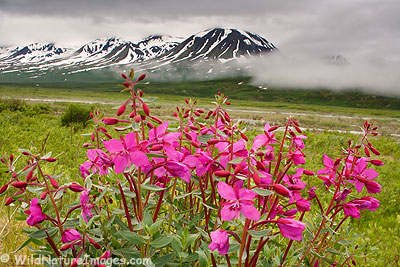
I have begun using the Canon tilt / shift lenses increasingly more in the past 6 months; I have the 24mm and 45mm. There are certain situations where having the ability to tilt or shift is really advantageous – I thought I would touch on tilt today, and shift tomorrow.
Many people mistakenly think tilting the lens gives you increased depth of field for a given aperture. That is probably a nice simple way to think of it, but isn’t exactly correct. Each aperture still has the same amount of depth of field, but instead of having the region in focus limited to a vertical plane, by tilting the lens the region in focus can now run in a more horizontal manner – in this case beginning at the flowers just a few inches away, and continuing to the mountains. By having the area of focus angle across the scene instead of running straight up and down, it now takes less depth of field to keep the foreground and background in focus. Interestingly enough, if the above photo lacked depth of field, the flowers and mountains could still be in focus, but the valley in between might not be, because I used a large amount of tilt. It takes a little to get used to using tilt.
The thing about a lens that can tilt is it now opens up all kind of fun opportunities. In this photo I’m laying on the ground just inches from the flowers – almost like a macro shot, but still have the mountains in focus. The possibilities are exciting. These maybe better examples; Grand Tetons, Red Rock Canyon.
In all these examples, I used a tripod and a fairly small aperture since I was already pushing the limits of depth of field. There are other advantages to having tilt. In situations where the foreground isn’t as close, you can tilt and use a much larger aperture then would normally be required such as f/8 – this is helpful when you need the extra shutter speed. A common example is shooting in a field of flowers with some wind. The trade off between stopping the movement and lack of depth of field can leave you with soft photos – but by tilting the lens, you can have the best of both worlds; a relatively fast shutter and adequate depth of field.
If you are not familiar with the lens I’m talking about, below is a photo of the 45mm pointed straight up and fully tilted to the left. As you can see, it doesn’t really tilt much, but even a little tilt can make a big difference.I really think one of these lenses could make a big difference when it comes to landscape photography.
I began with the Canon 45mm tilt / shift lens, and later purchased the Canon 24mm tilt / shift lens. One day I hope to finish my collection with the final lens from this series, the Canon 90mm tilt shift lens.


Comments 18
That is awesome Ron. I’ve been debating whether or not to get the 24 or not or even the 45mm, not sure which I’d use more. Do you use the 45mm more for architecture? I am more in need of a new camera and good telephoto lens though.
Author
Hi Richard,
I actually use the 24mm more for architecture. It seems like the ability to tilt is more valuable with the longer lenses like the 45mm. I started with the 45 and then added the 24 – I use them both equally. The 45mm is nice for panoramic, I think the 90 would even be more useful for panos.
Ron
Great info on T/S lenses Ron. I learned a few new things thanks to your great explanation. Nikon only makes a 85 mm T/S – I have always wondered how useful that focal length would be.
Pingback: free
Ron, I found this to be a great article. Which lens(es) did you use to take the above photo and the ones at the links you provided? In your previous reply you indicated that you don’t use the 24mm for landscapes much. Can you elaborate on why not? I’m interested in purchasing it over the 45mm for the increased angle of view.
Author
Hi Jay,
It seems like with wider lenses, I don’t battle depth of field limitations as much – but the 24mm would allow you to push the limits a little more then you typically could. The Red Rock Canyon photo linked above for example is actually with the 24mm. The photo above, and the Grand Teton image were both with the 45mm. For a comparison, here is a vertical of the same Grand Teton scene with the 24mm: Grand Teton
Really, you won’t go wrong with either one.
Great info Ron. I’m about to pull the trigger on a 24 and 90mm TS. If I keep my nerve I’ll keep you posted.
Author
Thanks Jim – keep me posted – I think you will really enjoy enjoy these lenses!
Ron
Got’m. I’m going to give them a run for their money while on my trip. BTW your recent photos and waterfall discovery are stunning. Always an inspiration.
Author
Thanks Jim. I think you will enjoy those lenses. If you find yourself out the Moab way, do let me know.
Ron
Hi Ron,
You positively stole the soul of Alaska! We don’t want any outsiders doing that. You can imagine my relief at finding out you are not only an Alaskan but a fellow Sewardite. I didn’t see what current camera and lenses you are using. I shoot (and I use that term loosely) a Canon digital rebel XT. It’s an older but still good camera. I would be honored to lug your equipment around for you!
Author
Hi Rick,
Hey thanks for the kind words, I appreciate it!
I was using a Canon 5D, and am now using a Canon 1Ds III. The Canon digital rebel is a good camera. Hopefully I will get a chance to meet you one of these days, I should be back in Alaska in a couple of weeks.
Thanks,
Ron
Pingback: O Tilt Shift «
Ron,
I have been considering a TS lens for over a year and your straightforward comments have convinced me that such a lens would be a worthwhile investment for me. However, Canon recently announced but has yet to deliver on two new TS lenses, a 17mm and a 24 mm II. The specs on the new 24mm lens are impressive. But the price point is nearly twice that of the current 24mm TS lens. Have you had a chance to evaluate the new 24mm lens? I would be interested in your assessment. And keep up the great work – your photos are awesome.
Joe
Author
Hi Joseph,
Thanks for the kind words, I appreciate it!
Those new tilt/shift lenses do sound impressive, but unfortunately, I haven’t used or seen one, nor do I know of anybody who has. I look forward to hearing more about them.
I have a Canon 24mm f3.5 TS-E II which I love, despite the fact that New England isn’t particularly planar. The ability to alter perspectives as well as control the orientation of the in-focus wedge changes how I think about photographs, and has been really instructive to my fixed-lens photography.
The 24mm is Canon’s only second generation L-series lens, so I trust its optics to be first rate, though I wonder what kind of loss of image quality would be evident in their 17mm and 90mm lengths. I’m really curious about the 17mm, as I like the effect objective lens tilt has on a broader field of view.
And BTW, it irks me to see “tilt/shift photography” defined as the art of photo-shopping images to have a limited field of focus, thus giving the illusion of miniaturism. That’s barely a skill, whereas actual view camera manipulations or, more recently, DSLR tilt/shift lenses require an entire skill set.
I’m not averse to counter-Scheimpflug photography; I’m just opposed to seeing it conflated with facile Photoshop trickery.
Author
Yeah, that seems like a funny definition for tilt/shift photography.
I haven’t used the 17mm. That would be a fun lens to own!
Ron
Another Good post, I will be sure to bookmark this post in my StumbleUpon account. Have a awesome evening.