From the category archives:

Ask Ron

What Camera do I use?

by Ron on December 6, 2010

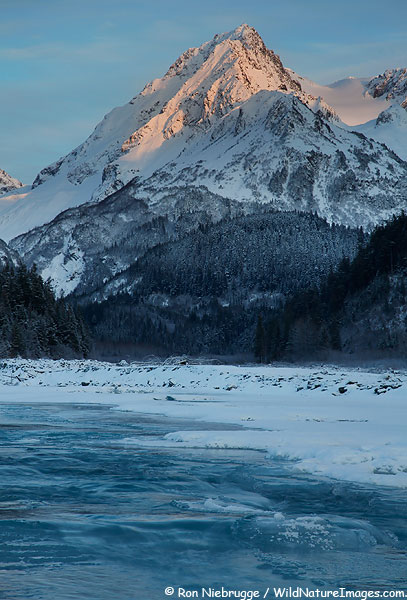
Yesterday afternoon along Fourth-of-July-Creek, Seward, Alaska.

Yesterday afternoon along Fourth-of-July-Creek, Seward, Alaska.

What camera do I use has to be the one question I get more then any other, so it makes for a perfect Ask Ron subject.

First, I thought I would add, I think it is a great question.  Unfortunately, for some reason I often see this question ridiculed on on-line photography forums with responses to the effect of ” no one ask Michelangelo what kind of brushes he used?”  As you might notice, photographers can have big egos, although in most cases I don’t think that they are really intending to compare themselves indirectly with Michelangelo.  But it really isn’t a good analogy as I have a feeling that today’s digital cameras make up a far greater percentage of most people’s discretionary income – far more so then a paint brush.  For such a large purchase, I think you should be asking what others use, what they like / dislike about the camera, etc. – I know I do.  And, it certainly is possible that people did ask Michelangelo what kind of brush he used – I bet he had tried a lot of brushes in his day and probably knew as well as anyone as to which worked and which ones didn’t.  But I digress.

So for me, for the last few years I have been using the Canon 1Ds Mark III.  Great camera.  When it was released it had just about all the latest features and the large full size sensor produced a wonderful, low noise, high quality image.  The thing was incredibly weather proof and built like a brick – unfortunately it weighed about as much as one too.

But, now that a couple of years have past, the features on the Canon 1Ds III were not nearly up to date – I really missed not having HD video.  The slow frame per second rate coupled with the slow auto focus made it less then ideal for wildlife, and about worthless for things like birds in flight.  I found the weight to be a pain at times as well.  So this September, before leaving on our last photo trip I decided to sell the 1Ds III and replace it before a new version was released and the value took a further hit.  I replaced it with two cameras, the Canon 5D Mark II and a Canon EOS 7D .  Actually the amount I received for the 1Ds III covered a good percentage of the cost of both the two newer bodies, so that made it an easy decision.

The Canon 5D II gave me an everyday camera with the same sized sensor as my 1Ds III, but in a much lighter body and with cool new features like HD video.  I used to own the original 5D, so the new version felt very familiar.  The 7D gave me a very good wildlife camera with its super fast auto-focus and frame rate, with pretty much all the latest bells and whistles including some cool features like the electronic level – no more hot shoe mounted bubble level!  It also has the identical control layout as the 5D Mark II – an important consideration when working with two bodies.

So how do I like the change?  So far I’m very happy with both cameras.  For one, I like having two bodies – most of my career, even back in the slide film days I have had two bodies, unfortunately that wasn’t possible with the 1Ds III because the thing was so expensive.  Two bodies not only give me a back up camera, but it allows me to keep a “wildlife setup” handy at all times even if I’m working on landscapes – a real plus in places like Denali.

As far as the individual cameras go, I think I will follow up with more specific thoughts on each one on a couple of future blog posts.

{ 20 comments }

Hiking in the Dark

by Ron on May 5, 2010

Sabino Canyon, near Tucson, Arizona and about an 45 minutes before a dark hike down this same hillside.

Sabino Canyon, near Tucson, Arizona and about 45 minutes before a dark hike down this same hillside.

Ron Richins asked this great question recently:

I just saw your last post about SabinoCanyon.  I also saw your post awhile ago about Tower Arch.  The one thing they have in common is that you hiked out in the dark from each location.  Do you have a lot of experience doing this, and does it get easier the more you do it?  I’ve only done a few hikes after dark, and they can be quite unnerving.  I wonder if you could share some tips about hiking prudently after dark.  A headlamp’s a must, but beyond that, what else do you do?  Do you follow tracks left by a GPS?  Or, am I just letting fear rule me more than reason?  This might make for an interesting blog post.

Actually, I don’t do too much hiking in the dark especially in Alaska.  Last summer I actually spent one night only a mile from my home in a tent rather then hike through a pitch dark bear infested forest. :)   There are enough bears around here already – but at night, it seems like every dark stump turns into a bear!

It was in Colorado and Rocky Mountain National Park that I really began doing dark hikes.  There, spending the night wasn’t an option because of restrictions, permits etc., so long hikes in the dark was the only way to be at many locations for sunrise or sunset.  It was easy down there thanks to well marked, well worn trails.  It worked out so well, that I began doing it in other areas -  places like Moab and Tucson like you observed.

So here are some observations:

-  Be extra observant for visual clues, junctions etc.  Even familiar trails look very different in the dark.  It much, much  easier to get lost or miss a trail in the darkness.  Reliable visual references such as mountains and other land features are often impossible to see in the dark.

-  Dark hiking is slow.  Even though it seems like I’m hiking really fast, I’m not!  Allow extra time even on a trail you are familiar – like 25% extra time.

-  A headlamp is a must.  Unlike a flashlight, a headlamp keeps both hands free, and always places the beam of light exactly where you are looking – which is where you want it!

-  I use an old Petzl.  During my last visit to REI I was really tempted to purchase this much brighter version:
Petzl Tactkka Plus LED headlamp
The thing I really like about the Tactikka Plus is the red filter which allows you to maintain your night vision.  I think that feature would be wonderful for night photography – star trails and northern lights.  Keeping your night vision while still having enough light to set up the camera would be a huge benefit.

-  Be sure your headlamps batteries are charged or fresh.

-  I carry a small can of bear spray.  I don’t remember where I bought this small can of spray – I think it might have been at a Bass Pro Shop.  I wouldn’t want such a small can in Alaska, but in the Southwest where I’m more concerned about mountain lions and people, I think it is a great size.

-  I make sure I know where I’m going.  I carefully look over maps and have a good feel for distances between junctions, directions etc.  I haven’t used my GPS on a night hike, but it probably isn’t a bad idea.  It would have been nice for our hike out from Tower Arch in Arches because the distance between cairns was greater then our light beam.  Fortunately on that hike I wasn’t alone.  I had Janine stop at the last cairn with her lamp, while I hiked out until I could find the next pile of rocks, then she could hike back toward my light and we repeated.  It was slow, but safe – especially given the steepness of the final hill.  A GPS cookie trail would have come in handy.

-  Go with a friend.  Not only is it safer like in the situation above, but it also makes it more fun and less spooky.  If I’m talking with someone then my mind is less likely to turn every stump into a monster like my mind does when I’m alone!

-  Be extra prepared.  I usually bring an extra shell or jacket, trail bars and water just in case I have to wait until morning to find my way.

I know what you are saying about how unnerving it can be when hiking in the dark – it is for me as well.  But, it does seem to get easier the more I do it.  I don’t think I will ever get to the level of comfort as I found in a young couple from South Africa.  I was camped late one summer night on the edge of the Harding Icefield in Alaska.  At 1:00 a.m in the total darkness they showed up without even a flashlight.  There are so many bears on that trail during the day, I can’t imagine making that long hike in the dark.  When I asked them about it the next day they just shrugged it off like it was nothing.

{ 9 comments }

Dark conditions like this scene from Seward earlier this winter is one time I can be "fooled" by the back of the camera preview.

Dark conditions like this scene from Seward earlier this winter is one time I can be "fooled" by the back of the camera preview.

Samantha Orchard provided me this Ask Ron question:

Do you check the in-camera histogram and/or the overexposure warning
option (blinking pixels) after you take a photograph? Or do you just look
at the image on the screen to determine if you need to use exposure
compensation, take exposure-bracketed shots, or otherwise re-adjust your
camera settings when you try the shot again?

Great question.  I set my camera to blink when there are flashing highlights – a camera setting available on many cameras.  Looking for “blinkies” is one of the first things I will do when evaluating an exposure as this represents lost data.  If I need to, I can usually recover detail in an underexposed area, but never in an overexposed “blinker”.

But, I try to always look at the histogram making sure the “mountain” of data isn’t getting cut off by being too far to the right (overexposed), or too far to the left (underexposed).

If I don’t look at the historgram and just judge exposure by how the image on the LCD looks, I find that I will often underexpose the photo when I’m working in dark conditions, presumably because the screen appears so bright compared to my dark surroundings.  Likewise, if it is really bright out I have trouble seeing the image on the back of the camera unless it is overexposed – so I find I tend to overexpose.  With the histogram I get a more objective measure of exposure – one that isn’t influenced by the viewing conditions.

If you have any questions about photography / locations etc., then you might want to check out Ask Ron.

{ 15 comments }

How do I use Bokeh?

by Ron on December 21, 2009

Least Sandpiper, Seward, Alaska.

Least Sandpiper, Seward, Alaska.

Megan from Costa Rica had an ask Ron question about bokeh.  Here it is:

Hi Ron, I had a quick question for your Ask Ron series.  I was wondering about your opinion of bokeh.  I have a basic understanding of the concept from online research, but it seems that some professional photographers absolutely love it, while others barely use it at all.  Also seems that subject matter doesn’t necessarily determine who likes it or not; in other words, I see some landscape artists use it all the time, and others never.  I’m contemplating buying my first fixed focal lens for my Nikon D60, and am curious what your take is, when and how you decide to “go for bokeh” (ha), etc.

Thanks!

Megan in Costa Rica

For those that aren’t familiar with the term, here is the Wikipedia definition for bokeh: In photography, bokeh is the blur, or the aesthetic quality of the blur, in out-of-focus areas of an image, or “the way the lens renders out-of-focus points of light.

For me, I often use it for wildlife portraits, and close-up work like flowers – it allows me to isolate the subject from the rest of the scene and effectively “remove” distracting elements.  I think the bird portrait above is a good example.  Here I am actually laying in the cold water with the front of the lens and camera just barely out of the water in order to throw the background out of focus.  If I was just a foot higher off the ground, I could be warm and dry, but the background of mud would come into focus and could be a distraction.

The background is often ignored, but can often make or break an image.  As I’m setting up on birds like this, I’m not just watching the birds movement and the direction of the light, but I am constantly evaluating the background.  A bright spot, even if it is out of focus will draw your eye right away from the subject and to the background bright spot.

Now I don’t always try to throw the background out of focus, there are times that it can enhance an image, and provide the viewer with a feeling for the habitat and surrounding environment.  This photo of a desert bighorn near Moab, Utah is one example that comes to mind.

Now you mention landscape photography, and myself, I chose to maximize depth of field and keep everything in focus.  I know some photographers utilize limited depth of field as a personal style, it seems to have gained in popularity in recent years.  I encourage you to experiment.  A prime lens with a large aperture can be a lot of fun creatively.

Thanks for the question – you live in a beautiful country!

{ 8 comments }

How do I capture so much depth of field?

by Ron on December 17, 2009

Pedersen Glacier, Kenai Fjords National Park, Alaska.

Pedersen Glacier, Kenai Fjords National Park, Alaska.

It has been awhile since I have answered any Ask Ron questions.  As a reminder, I will answer any photography question as best I can.

A couple of weeks ago I received this question:

I love how you capture a foreground, middle ground background with such great depth.
Do you typically try to accomplish this with a 24 T/S or the 24 1.4L?
Thanks, Ray

To answer your question, yes I do use Canon’s tilt shift lenses a fair amount.  By tilting the plane of focus I am better able to position the depth of field from near to far without sacrificing a lot of shutter speed.  I go into more detail in this post on tilt with Canon’s tilt shift lenses.  These lenses are especially valuable when you have something really close, say within a couple of feet, and still want to keep distant objects in focus.

But, I don’t use those lenses as much as I should.  It is so much easier, faster and lighter to carry one 24-105 then three tilt shift lenses.  In these circumstances, I use a small aperture to maximize depth of field – usually around f/16.  I then focus about 1/4 to 1/3 of the way into the scene.  I also almost always will use a tripod, mirror lock up and the 2 second self timer to minimize any movement as much as possible.  This is about as good as it gets without tilt.  If something still has to be a bit out of focus I would rather it be distant objects – I believe prominent foreground elements have to be sharp – distant objects like mountains can be more forgiving.

Tomorrow I will answer another recent question on depth of field – this one regarding bokeh.

{ 11 comments }

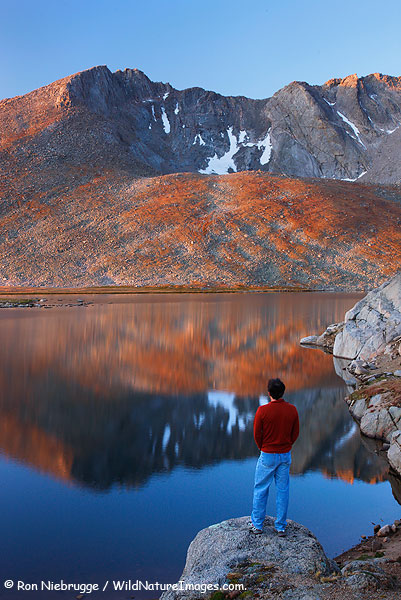
Summit Lake, Mount Evans, Colorado

by Ron on September 11, 2009

Summit Lake, Mount Evans, Colorado.

Summit Lake, Mount Evans, Colorado.

This lake sits at 12,830 feet – and there is a road to it!  In fact, the road continues to the top of Mount Evans in the distance at 14,264 making it the highest paved road in North America.  Unfortunately it is closed beyond Summit Lake after the Labor Day weekend.
When I was hiking around, the elevation really wasn’t noticeable – but at one point I realized my battery was going to die, so I ran back to the truck for another one, and wow – that air is thin!
My super model slept in this morning, so you get stuck with a rare photo of me today!

{ 14 comments }

A pond with Mt. Alice in the background, Seward, Alaska.

A pond with Mt. Alice in the background, Seward, Alaska.

As part of my Ask Ron series, Phil Cola asked what is my top selling photo in terms of revenue, and what was the location, setup, logistics etc.

It is a great question – I know I’m always fascinated by the annual issue of Photo District News (PDN) in which the major stock agencies share the same information on their most successful image from the prior year.  My most successful images draw on some similar parallels that I will touch on below.  [click to continue…]

{ 12 comments }

What to do with my old slides?

by Ron on May 22, 2009

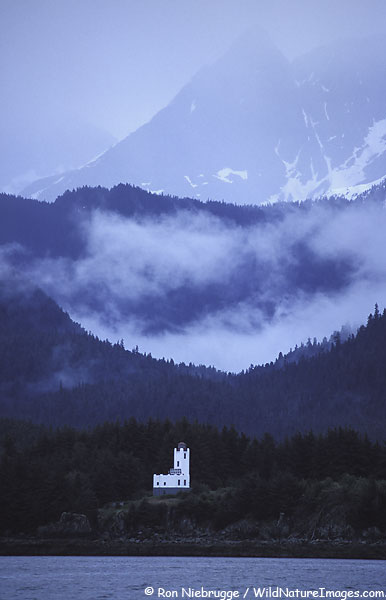
Sentinel Lighthouse, Southeast Alaska.

Sentinel Lighthouse, Southeast Alaska.

One of our regular magazine clients contacted us earlier this week looking for photos of the Sentinel Lighthouse – they were unable to find one on our website.  So we dug through our old slide files and sure enough found this image which we scanned and sent off.  We have thousands of old slides like this that may have some value, but most just sit and take up valuable room in file cabinets.  [click to continue…]

{ 3 comments }

Where to go in Costa Rica?

by Ron on May 1, 2009

A hanging bridge in the rain forest, Arenal, Costa Rica.

A hanging bridge in the rain forest, Arenal, Costa Rica.

Fellow Alaskan Dan Kehlenback is looking to travel to Costa Rica next winter, and asked Ron for recommendations on a general area in Costa Rica for photography.   [click to continue…]

{ 9 comments }

Kayaking and Camera Gear?

by Ron on April 29, 2009

Kayaking in Prince William Sound, Alaska.

Kayaking in Prince William Sound, Alaska.

As part of the ask Ron theme, adventure photographer Ryan Bonneau asks how I handle my camera gear while kayaking.  Ryan is going to be spending two months kayaking in Prince William Sound this summer (lucky guy!).  He went on to say he has tried storing his gear on deck in a dry bag, as well as in his cockpit in a dry bag, and has never felt comfortable with either system.

Well, unfortunately I don’t have a solution for this one.  I do the same thing as Ryan, and have never felt comfortable with those options either.  Usually I keep my camera in a dry bag under the bungees on the deck in front of me, kind of like the yellow bag you see in this photo.  My camera’s dry bag is red – it is probably sitting on my skirt and just out of sight in this photo.  Getting the camera in and out of the bag and stowed away is always a wet, awkward proposition full of risk – I dread hearing that plunking sound of a lens dropping overboard, so far I have been fortunate.  I’ve seen this topic come up in photography forums, but have never heard of a better solution.

By the way, the dark area between both bows is a large school of salmon.

I hadn’t seen Ryan’s photography until today – check it out, he has some great stuff.  Looks like he just started a blog as well.

{ 10 comments }

Camping in the Chuach National Forest, Alaska.

How do I handle the power needs for my digital camera and file storage on long trips away from electricity?  This was an ask Ron question brought up by two fellow blog’en photographer friends of mine Richard Wong and Gary Crabbe.  Both guys operate great blogs – blogs I read everyday, so if you have extra time, do check them out.   [click to continue…]

{ 11 comments }

A ferris Wheel at night, Long Beach, California.

A ferris wheel at night, Long Beach, California.

Well I hate to post the same photo twice, especially in the same week, but in response to my ”ask Ron” request, this was the most asked question.  More specifically, Dennis Barton wanted to know how many tries it took to capture this image, while Sheri Lyons wondered how the photo came to look like this. [click to continue…]

{ 7 comments }

Ask Ron

by Ron on April 18, 2009

A ferris Wheel at night, Long Beach, California.

A ferris wheel at night, Long Beach, California.

 I thought I would try a new idea with the blog and create an Ask Ron category.  My thinking is that every so often I would answer reader submitted questions and publish the question and my response here on the blog.  They can be pretty much anything photography related, from travel destinations, gear, techniques, thoughts and opinions – you get the idea.  If there is a photo you have always wondered about, maybe the story behind the image, that would be good too.

If you have a web presence; website, blog, Flickr page, I would be happy to link back in my response.  If you would prefer to remain anonymous, that’s cool too. 

You can post your questions in this thread, or feel free to email them to me at ronn@arctic.net  If you could, put “Ask Ron” in the subject so that I will know it is for the blog and not just someone asking a question.

I will do my best to answer all questions as best I can, but I will have editorial control, so I could decide to ignore a question – heck, it is my blog.  :)   So if I start posting photos of a wolverine den, chances are slim that I will provide the GPS coordinates.  Likewise, asking for the name and number of the photo editor at XYZ magazine probably won’t get a response either, but most stuff will be fair game.  So hit me with your Q’s!

Hey, speaking of wolverine.  Now that we are heading into spring, I figure it might be a good time to remind everyone that my deal from last year is still on!

Related Posts Plugin for WordPress, Blogger...

{ 13 comments }